|

The
eye is a wonderful organ that gives us the ability to
see the world around us. Many people think the eye is
just one sphere, orglobe. It really is composed of two
spheres with different radii, one set into the other.
The front sphere, called the anterior, is smaller and
more curved of the two. This is called the cornea. The
second sphere is called the sclera. The cornea sets
into the sclera much like the glass on a watch sets
into the frame. The cornea and the sclera are the structures
that encase and protect the different and more delicate
structures within.
First
we will explain some of the refractive errors (the reason
we need glasses) then explain what some of the parts
of the eye are and there function.
|
What
is nearsightedness ?
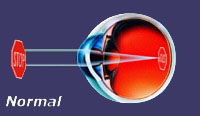
Nearsightedness
(myopia) is when the eye is too long or the curvature
of the cornea is too steep and the focus of the
rays of light that enter the eye fall short of
the retina. The result, is a blurry view of distant
objects.
|
|
|
What
is astigmatism ?
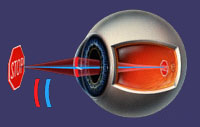
Astigmatism
can exist alone or in combination with nearsightedness
or farsightedness. With this condition the cornea
becomes oval-shaped like a football instead of
round, causing distortion when the eye tries to
focus.
|
|
|
What
is farsightedness ?
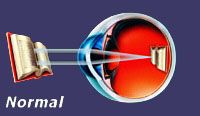
Farsightedness
(hyperopia) occurs when an eye is too short or
the curvature of the cornea is flat. Light rays
entering the eye focus behind the retina, and
as a result a blurred image is produced, especially
with near objects.
|
|
|
What
is presbyopia ?
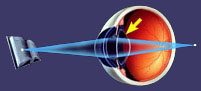
Presbyopia
is when the lens of the eye looses the ability
to change focus. This occurs as part of the natural
aging process and usually begins around 40 to
45 years of age. When we lose this ability to
change focus it prevents us from seeing both near
and distance simultaneously. A person will need
to have extra magnification in his or her glasses
in the bottom or bifocal part. A nearsighted person
over 40 or 45 years of age will be able to see
up close if they remove their glasses since their
eyes naturally focus at near, but if they wear
distance glasses they will then need a bifocal
if they want to see near. Since this is part of
the natural aging process, a person will develop
the lens changes whether they have refractive
surgery or not.
|
|
|
Anatomy
of the Eye
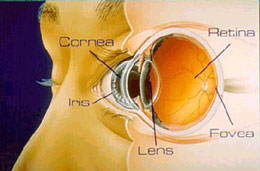
Cornea :
The
cornea is the clear front surface of the eye.
This clear tissue is like a window for the eye.
It is composed of 5 different layers. The outer
layer is called the Epithelium then comes the
Bowman's Membrane, then the Stroma, then Descemet's
membrane, the fifth layer is called the Endothelium
and is on the inside of the eye. The cells and
fibers in the cornea are arranged so that light
can pass through it with a minimum of diffraction
and internal reflection. The cornea contains no
opaque substances such as blood vessels that would
mar it's clarity. It receives its nourishment
from the vessels surrounding the cornea. It is
kept shiny and lubricated by tears that keep its
surface moist.
|
|

Lens :
The
lens of the eye is a transparent biconvex structure
situated between the iris and the vitreous (a clear
jelly- like fluid in the back of the eye). Most of the
lens is hidden behind iris tissue, only the portion
that is directly behind the pupil is visible. It is
attached to the eye by means of fine suspensory ligaments
called zonular fibers. A capsule, sort of like a transparent
highly elastic envelope, surrounds the lens. The lens
tissue inside the capsule is rather soft and puttylike
in infants. With age it tends to grow harder, especially
toward the center of the lens. The lens has the ability
to change shape, which helps to bend the light as it
passes through the eye. This helps to focus the light
rays onto the retina.
Retina :
The
retina is to the eye like film is to a camera. The retina
contains all the sensory receptor for the transmission
of light. It collects all the information and sends
it to the brain. But the retina is also a part of the
brain. The retina has two types of receptors, rods and
cones. The rods function best in dim light; the cones
function best under daylight conditions. There are many
more rods than cones in the retina. Color vision is
dependent on the integrity of the cones. The cones form
a concentrated area in the retina known as the fovea,
which lies in the center of the macula. Damage to this
area can severely reduce the ability to see directly
ahead. The macula is the area of the retina that we
use for our fine and straight-ahead vision. If the macula
or fovea are damaged, a blind spot appears in the central
vision. Rods are in the periphery of the retina, not
in the macula. If these are damaged, it can result in
night blindness, but with good vision for straight -
ahead objects.
|